


Some error occured while loading the Quick View. Please close the Quick View and try reloading the page.
A free ebook version of this title is available through Luminos, University of California Press’s Open Access publishing program for monographs. Visit www.luminosoa.org to learn more.
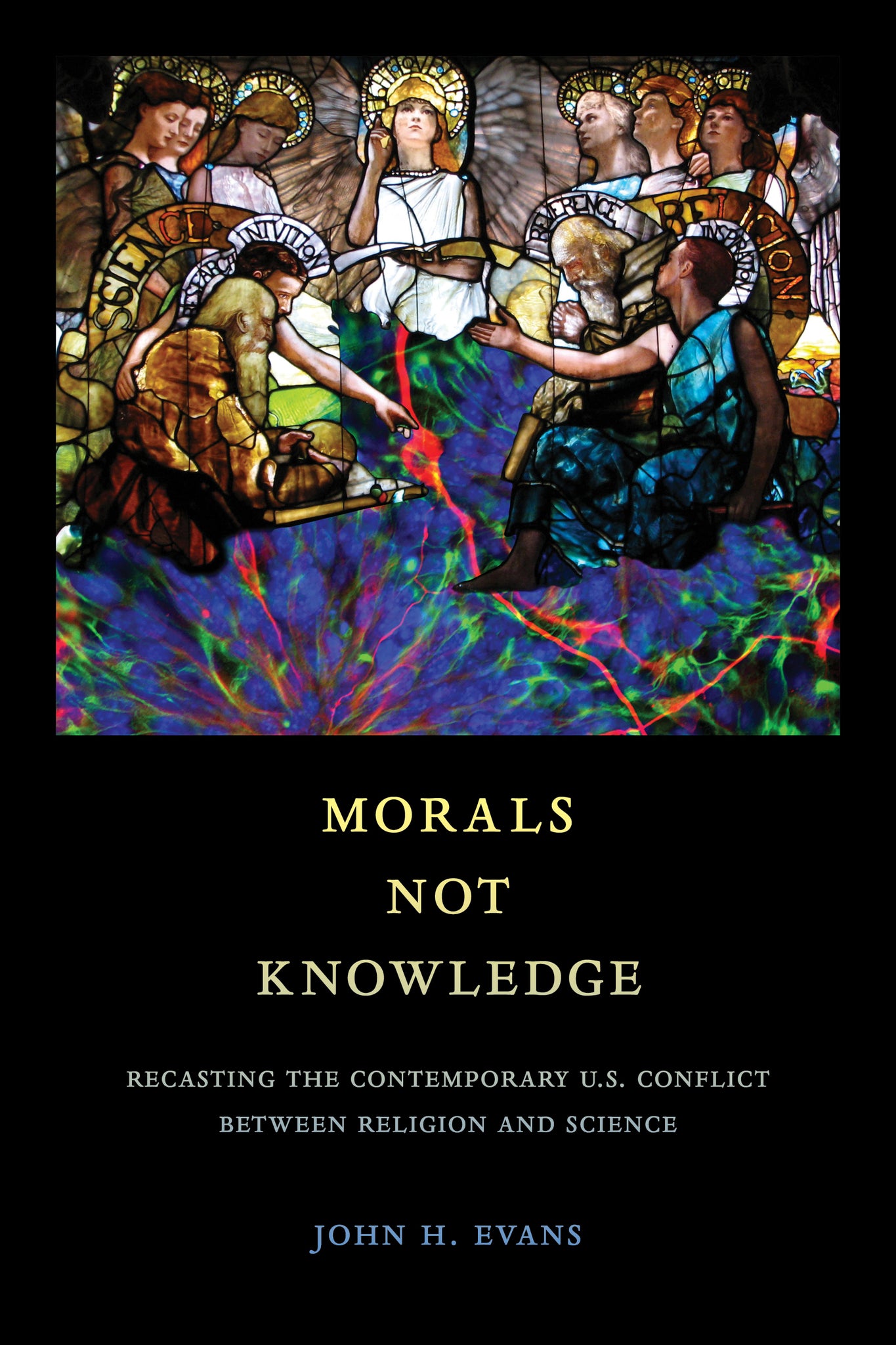
In a time when conservative politicians challenge the irrefutability of scientific findings such as climate change, it is more important than ever to understand the conflict at the heart of the “religion vs. science” debates unfolding in the public sphere. In this groundbreaking work, John H. Evans reveals that, with a few limited exceptions, even the most conservative religious Americans accept science’s ability to make factual claims about the world. However, many religious people take issue with the morality implicitly promoted by some forms of science. Using clear and engaging scholarship, Evans upends the prevailing notion that there is a fundamental conflict over the way that scientists and religious people make claims about nature and argues that only by properly understanding moral conflict between contemporary religion and science will we be able to contribute to a more productive interaction between these two great institutions.
In a time when conservative politicians challenge the irrefutability of scientific findings such as climate change, it is more important than ever to understand the conflict at the heart of the “religion vs. science” debates unfolding in the public sphere. In this groundbreaking work, John H. Evans reveals that, with a few limited exceptions, even the most conservative religious Americans accept science’s ability to make factual claims about the world. However, many religious people take issue with the morality implicitly promoted by some forms of science. Using clear and engaging scholarship, Evans upends the prevailing notion that there is a fundamental conflict over the way that scientists and religious people make claims about nature and argues that only by properly understanding moral conflict between contemporary religion and science will we be able to contribute to a more productive interaction between these two great institutions.

Price: $34.95
Pages: 238
Publisher: University of California Press
Imprint: University of California Press
Publication Date:
09 February 2018
Trim Size: 9.00 X 6.00 in
ISBN: 9780520297432
Format: Paperback
BISACs:
"John H. Evans has written a well-researched, multi-disciplinary text that speaks to our current historical moment. Using the sociology of religion; the history of sociology, science, and science's relationship with religion; and data sets from surveys and in-depth interviews, Evans explores and troubles the alleged 'foundational knowledge conflict' between religion and science."
John H. Evans is Professor of Sociology at the University of California, San Diego.
Acknowledgments
1. Introduction
2. The Religion and Science Advocates in the Academic Debate
3. The Academic Analysts of the Relationship Between Religion and Science
4. The Recent Transformation of Elite Academic and Public Debates
5. Existing Research on the Public
6. Empirical Tests of Knowledge and Belief Conflict for the Religious Public
7. Empirical Tests of Moral Conflict for the Religious Public
8. Conclusion
Notes
Works Cited
Index
1. Introduction
2. The Religion and Science Advocates in the Academic Debate
3. The Academic Analysts of the Relationship Between Religion and Science
4. The Recent Transformation of Elite Academic and Public Debates
5. Existing Research on the Public
6. Empirical Tests of Knowledge and Belief Conflict for the Religious Public
7. Empirical Tests of Moral Conflict for the Religious Public
8. Conclusion
Notes
Works Cited
Index